Conveyor Belt, Counter, or Table? How to Choose a Sushi Restaurant in Japan
From kaiten-zushi chains to counter omakase — Kaa-chan's honest guide to every sushi style in Japan.
Maybe you've already tasted it — and found yourself thinking, what is that flavor?
How often do Japanese people actually eat sushi? And where do they eat it? The answer might surprise you.
If you've been picturing every Japanese person making weekly trips to a high-end counter where a master chef hand-crafts each piece in silence — that's a lovely image, but not quite the reality. 😄
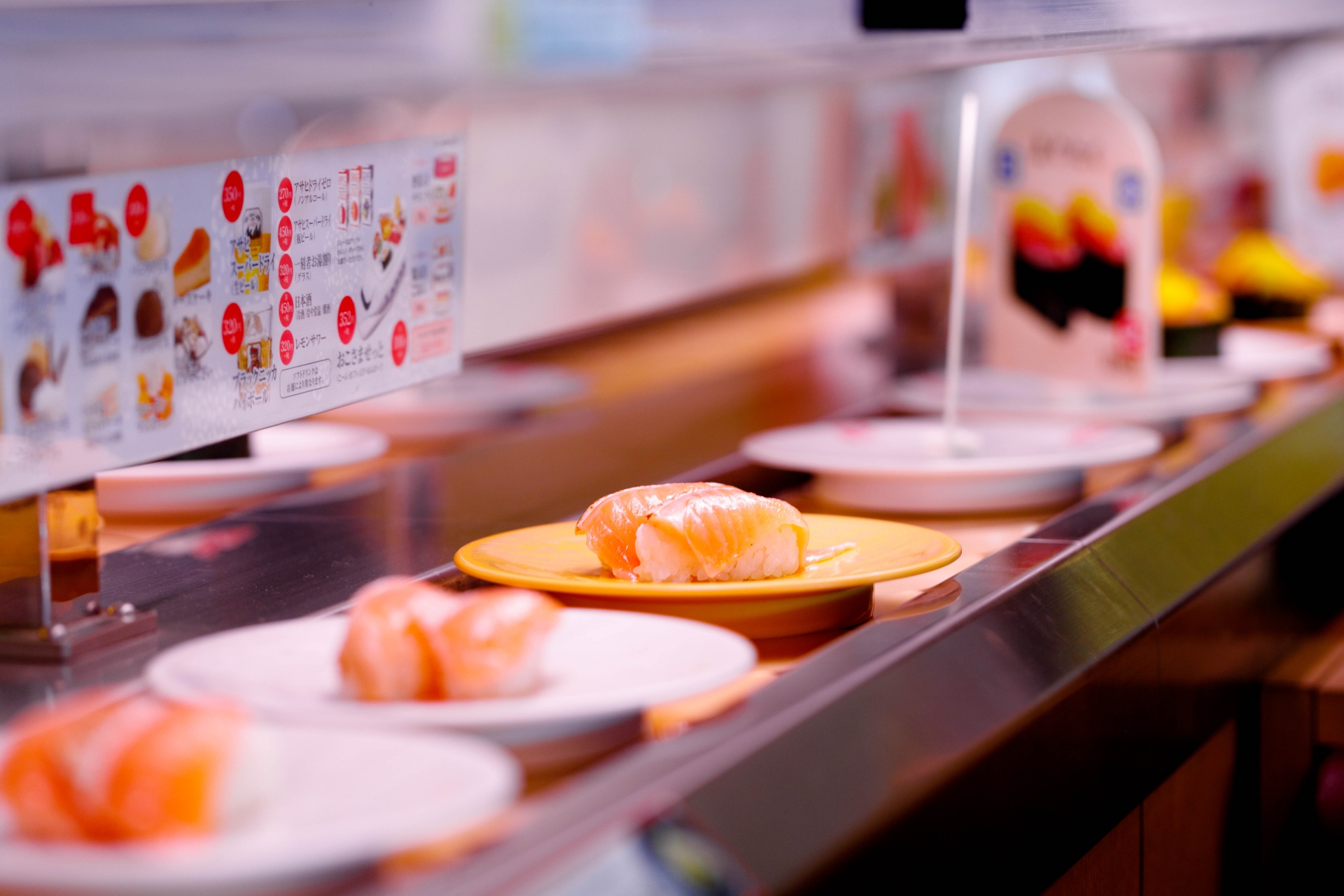
In fact, more than half of the sushi market in Japan by revenue comes from kaiten-zushi (回転寿司) — conveyor belt sushi. And surveys suggest over 70% of Japanese people regularly eat their sushi there.
So yes: sushi in Japan is both a special-occasion luxury and a completely ordinary everyday meal. Both things are true at the same time.
Here's Kaa-chan's guide to the real landscape of sushi restaurants in Japan — what each style is actually like, and how to pick the one that's right for you.
① Kaiten-zushi (回転寿司) — Kaa-chan's Top Pick for First-Timers
If this is your first sushi restaurant in Japan, Kaa-chan's honest recommendation is kaiten-zushi. Not just because it's fun — though it absolutely is — but because it's genuinely built for comfort.
The Showa & Heisei Era "Fresh Plate" Wars
Before all the high-tech upgrades, the unspoken rule at kaiten-zushi was simple: you eat what's on the belt. Asking the chef to make something specifically was only for toppings that weren't already circulating.
But everyone wanted fresh-made over belt-circulated. So a quiet psychological game developed. The moment someone called out "uni, please!" to the chef, every nearby customer suddenly perked up — and the instant that freshly made plate hit the belt, hands darted out from every direction. 😄
Now? You tap the touchscreen, and your order arrives via a dedicated express lane directly to your seat. No competition required. Kaa-chan thinks this is a genuine improvement.
Two Styles to Choose From Today
Modern kaiten-zushi in Japan has split into two distinct experiences.
Large family chains (machine-pressed rice) are all about speed, value, and accessibility. Touchscreens in multiple languages, photos of every item, and a menu that goes well beyond sushi — ramen, tempura, desserts, the works. If someone in your group isn't into raw fish, they'll still find plenty to eat. Maximum friendliness, minimum stress.
Craftsperson chains (hand-pressed by a chef) have a professional chef on the other side of the belt making each piece by hand. A step up in price, but also in quality — the kind of experience that satisfies even someone who usually prefers a traditional counter. The convenience of touchscreen ordering, the quality of a proper sushi restaurant.
Either way, the bill is simply the number of plates you ate. Transparent pricing, your own pace, total freedom to try whatever catches your eye. For a first-timer, it doesn't get more reassuring than this.
The 3 Free Things at Your Table — and What to Do With Them
Sit down at any kaiten-zushi and you'll find the same three items waiting. Here's what they're for.
Oshibori (おしぼり / wet towel) — A disposable wet towel for wiping your hands before eating. Since sushi is often eaten with fingers, starting clean matters. Kaa-chan will be honest: one is never quite enough. 😄
Konacha (粉茶 / green tea powder) and hot water tap — There's a small canister of green powder and a hot water spigot at your seat. Spoon one or two scoops of powder into your cup, press the cup against the spigot to fill it, and you have freshly made hot green tea. It cuts through rich, fatty toppings beautifully — an essential companion to sushi in Japan. The water tends to be very hot, so take care.
Gari (ガリ / pickled ginger) — The thin, pale pink slices in the box on the table. Not just a garnish — gari is a palate cleanser. A small bite between pieces resets your mouth, so the delicate white fish after a rich tuna comes through clearly. This is what it's actually for.
Know these three things and you'll look like a local from the moment you sit down. 😄
Kaa-chan's Tip: In the Regions, Find a Local Chain
Here is Kaa-chan's biggest piece of advice for traveling around Japan: when you're outside Tokyo, find the local kaiten-zushi chain that people from that area actually love.
The freshness of fish at a coastal or regional restaurant is on a completely different level from anything in the city. High-end Tokyo sushi counter quality, at a fraction of the price. Ask someone local: "What's the good kaiten-zushi chain around here?"
Two memories that still stop Kaa-chan cold:
At Toriton (トリトン) in Hokkaido, Kaa-chan ordered hokkigai (北寄貝 / surf clam) — and it was so thick, so plump, so shockingly fresh that Kaa-chan genuinely couldn't speak for a moment. Kaa-chan loves shellfish, but nothing had prepared for that. Hokkaido's ocean is something else entirely.
A friend from Niigata recommended a local chain on a visit. The nodoguro (のどぐろ / blackthroat seaperch) there — fat so rich and refined it melted without a trace — was one of the most quietly overwhelming things Kaa-chan has ever eaten.
Hokkaido: uni, ikura, hotate — from some of the coldest, most productive waters in Japan. Kyushu: aji, saba — blue fish raised in the rough currents of the Genkai Sea. Kanazawa and Niigata: nodoguro, shiro-ebi — fish that only come from the Sea of Japan side, only available where they're caught. A local chain in the right region is always worth finding.
② Table-Seat Sushi Restaurants — Relaxed, Underrated, and Worth Knowing About
"Kaiten-zushi is great, but Kaa-chan wants something a little calmer. Real chef-made sushi. Just... not ready for the counter yet."
If that sounds like you, the table seats (テーブル席) at a neighborhood sushi restaurant are exactly the right move.
At the counter, the chef is right there — and it's easy to feel like you need to order immediately, keep up, say the right thing. At a table, you set your own pace. No pressure.
Most table-seat restaurants have proper menus with photos and prices. Take your time. And if lunch is an option — as Kaa-chan discussed in the first article of this series — a lunch set means fixed content, fixed price, no surprises. Perfect for families, first-timers, or anyone who just wants to enjoy the food without doing mental arithmetic.
③ The Sushi Counter (カウンター席) — Intimidating, but Not Scary
And then there's the counter. The one everyone pictures. A chef in front of you, pressing each piece by hand, one at a time.
The word jika (時価 / market price) appears on many menus — meaning no fixed price listed. That part can feel daunting. Kaa-chan gets it.
Forget the Etiquette Rules — Just Be Considerate
Travel guides love to list sushi etiquette: how to hold chopsticks, how to dip the fish not the rice into soy sauce, and so on. Kaa-chan's honest take: don't worry about any of it.
Eat with fingers or chopsticks, whichever feels right. Smile. Enjoy the food. That's what a chef actually wants to see. If wasabi is a problem, just say "No wasabi, please" at the start — it'll be handled without any fuss.
The one thing that does matter: be considerate of the space and the people around you. Keep the noise down, be aware of others. That's genuinely all it takes. 100% no problem.
Kaa-chan's Counter Strategy
Even now, walking into an unmarked-price counter restaurant at dinner takes courage — Kaa-chan will say that plainly. 😄
So here's the approach: if a counter restaurant catches Kaa-chan's eye, the first visit is always at lunch. Check the price range on the board outside, read some reviews, get a sense of the atmosphere. Once it feels manageable, dinner becomes a possibility.
Eat well, stay within budget, leave full and smiling. That's 100 points at any restaurant, at any price point.
Three articles into the sushi series, and here's the conclusion: when in doubt, kaiten-zushi. Always.
Kaa-chan has written at length about stepping up to the counter, and all of it is true. But an unmarked-price dinner counter is still very much an aspirational destination. If anyone reading this ever wants to take Kaa-chan along — the invitation is very much open. 😄
— Mogu Mogu Kaa-chan
A Japanese mom who has eaten at kaiten-zushi more times than she can count — and has absolutely no regrets.