What to Order at a Sushi Restaurant in Japan — Kaa-chan's Cheat Sheet
Not sure what to order? Kaa-chan breaks down every topping, what it tastes like, and the order to eat them in.
Maybe you've already tasted it — and found yourself thinking, what is that flavor?
In Kaa-chan's last article, the message was simple: forget the rules, start with a lunch set, and just enjoy yourself.
But then you're actually standing in front of a sushi counter — or staring at a kaiten-zushi touchscreen — and the question hits: what even is this topping? What does it taste like?
So here's Kaa-chan's cheat sheet. No complicated theory. Just the things that will help you enjoy a Japanese sushi restaurant to the fullest — pull it up on your phone when you're at the restaurant and use it however you like.
Learn the Toppings in 6 Groups
Don't overthink it. Grouping them like this makes it much easier to pick something that matches your mood.
Akami (赤身) — Deep, Savory Flavor
- Maguro / Tuna (まぐろ) — The icon of Japanese sushi. Rich umami with a clean finish.
- Chutoro (中トロ) — Between akami and otoro. The perfect balance of fat and umami.
- Otoro (大トロ) — The most prized cut of tuna. Intensely fatty, melts the moment it hits your tongue.
- Katsuo / Bonito (カツオ) — Best in early summer and autumn. Bold, distinctive flavor with a satisfying chew.
Shiromi (白身) — Delicate and Clean
- Tai / Sea Bream (タイ) — The king of white fish. Elegant sweetness, best in spring.
- Hirame / Flounder (ヒラメ) — Subtle and refined. The more you chew, the more flavor comes through.
Fatty Fish — Rich and Full-Flavored
- Salmon (サーモン) — Sweet fat, smooth texture. The runaway favorite at kaiten-zushi. Note: many traditional non-rotating sushi restaurants don't carry it, as they prefer domestic fish.
- Buri / Hamachi / Yellowtail (ブリ・ハマチ) — Best in winter. Silky fat with a gentle sweetness. Hamachi is the younger fish.
- Kanpachi / Greater Amberjack (カンパチ) — Best in summer. Leaner than buri, with a firm bite.
Hikarimono (光物) — The Adventurous Choice
Silver-skinned small fish — aji, saba, iwashi, kohada — cured with vinegar and salt by the chef. They have a bold, distinctive flavor that might feel intimidating at first. But when a skilled chef has done the prep work properly, the sourness is mellow and the depth is remarkable.
- Aji / Horse Mackerel (アジ) — Rich and flavorful when fresh.
- Saba / Mackerel (サバ) — Strong blue fish flavor. Once it gets you, it really gets you.
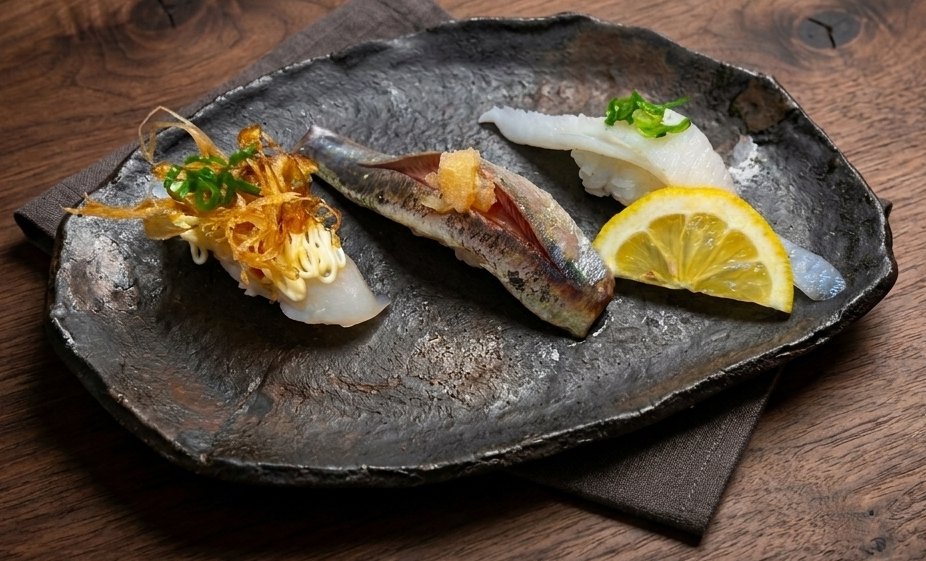
- Iwashi / Sardine (イワシ) — Soft, fatty, deeply savory.
- Kohada / Gizzard Shad (コハダ) — The hikarimono classic. A true test of the chef's skill.
Shellfish, Squid & Octopus — All About Texture
- Hotate / Scallop (ホタテ) — Sweet and springy. Sometimes served lightly seared.
- Akagai / Ark Shell (赤貝) — Crunchy texture, briny ocean aroma.
- Awabi / Abalone (アワビ) — A luxury item. Firm chew with deep umami.
- Ika / Squid (イカ) — Varies wildly by type — from sticky-sweet to clean and snappy.
- Tako / Octopus (タコ) — The more you chew, the more flavor comes out. A Japanese staple.
Shrimp & Crab — Sweet and Satisfying
- Ebi / Shrimp (えび) — Springy and sweet. Cooked through, so no worries.
- Amaebi / Sweet Shrimp (甘えび) — Served raw. Melts in your mouth with natural sweetness.
- Kani / Crab (カニ) — Best in winter. Delicate texture, rich flavor. A premium pick.
Everything Else — Full of Character
- Uni / Sea Urchin (ウニ) — Creamy, intensely sweet, deeply oceanic. Usually served as gunkan-maki. All about freshness.
- Ikura / Salmon Roe (イクラ) — Soy-marinated fish eggs. They pop in your mouth.
- Tamago (玉子) — Lightly sweet dashimaki egg. A quiet way to taste the restaurant's dashi.
- Anago / Sea Eel (あなご) — Fluffy, tender, with a sweet-savory glaze. Completely different from unagi.
- Kappa-maki (かっぱ巻き) — Thin cucumber roll. Fresh and palate-cleansing.
- Natto-maki (納豆巻き) — Fermented soybean roll. Divisive, but a true Japanese classic.
- Inari-zushi (いなりずし) — Sushi rice stuffed inside aburaage — thin deep-fried tofu pockets simmered in a sweet and savory sauce. A comforting classic.
Tuna Comes in 3 Cuts — and They Taste Completely Different
At a Japanese sushi restaurant, maguro (tuna) holds a special place. Same fish, very different experience depending on the cut and the grade.
- Hon-maguro (本まぐろ) — Bluefin tuna. The most prized, with an unmatched depth of flavor. Priced accordingly.
- Minami-maguro (みなみまぐろ) — Southern bluefin. Close to hon-maguro in quality, with a rich, fatty finish. Mid-range.
- Bincho (びんちょうまぐろ) — Albacore. Pale flesh, milder flavor. The everyday tuna at kaiten-zushi. Very affordable.
Within hon-maguro itself: akami → chutoro → otoro, moving from lean and savory to rich and meltingly fatty.
Kaa-chan's tip: Kaiten-zushi tuna is genuinely good. But a proper restaurant's hon-maguro — with better sourcing and handling — is a completely different texture. Try them side by side sometime. The difference is immediate.
Why Hikarimono (光物) Is Worth the Leap
Silver-skinned fish — saba, aji, iwashi, kohada — are called hikarimono. Fatty, intensely flavored, and yes, a little intimidating at first. But a chef who has done the vinegar-and-salt curing properly produces something with no sharp sourness and a mellow, layered depth that's hard to find anywhere else.
Kaa-chan's tip: Kaa-chan's husband's absolute favorite is kohada. With hikarimono, freshness and the chef's technique are everything. At a restaurant you trust, there's zero fishiness — just the real depth of the fish. It might stop you in your tracks. 😄
Knowing Shun (旬) Makes the Trip More Interesting
Japan has four distinct seasons, and each one brings fish at their absolute peak. That peak moment is called shun (旬). If you're visiting Japan, eating what's in season is one of the best things you can do.
- Spring: Sea bream (madai), sawara (Spanish mackerel), firefly squid (hotaru-ika)
- Summer: Bonito (katsuo), sea urchin (uni), abalone (awabi), greater amberjack (kanpachi)
- Autumn: Pacific saury (sanma), returning bonito (modori-gatsuo), salmon roe (ikura)
- Winter: Yellowtail (buri), cod (tara), snow crab (zuwai-gani), bluefin tuna (hon-maguro peaks in winter)
Kaa-chan's tip: If you're sitting at the counter, ask the staff: "Ima, ichiban oishii neta wa nan desuka?" (今、一番美味しいネタは何ですか?) — "What's the best topping today?" They'll point you straight to what's freshest. 😄
A Suggested Order — If You Want to Taste Everything Properly
Kaa-chan said it before: there are no real rules. Order what you want. But if you'd like to experience the full flavor journey, here's a loose sequence that works well:
- Start with something cooked — tamago or ebi — to ease in
- Move to delicate white fish — hirame or tai
- Step up to akami for deeper umami
- Then the richer cuts — chutoro, or fatty fish like buri
- Finish with the bold and distinctive — hikarimono, uni, ikura
The logic: if you open with otoro, the delicate white fish that comes after will taste like nothing. Building up gradually means each piece has somewhere to go.
The Moment That Changed How Kaa-chan Thinks About Sushi
Here's a confession: in Kaa-chan's younger days, it was all about the fat. Otoro, otoro, otoro. The chef's prep work? Never thought about it once. (Salmon, by the way — wildly popular overseas — has never really been Kaa-chan's thing. Something about the flavor. But sushi itself has always been a deep love.)
That started to change when Kaa-chan began sitting at proper counters and actually watching what the chefs were doing.
Take ebi. Kaa-chan used to assume raw always meant fresher, better. Then a chef served shrimp that had been cooked to exactly the right point — and the sweetness and the snap of the texture were something else entirely. Tight, dense, full of flavor. Not the soft richness of raw. A different kind of excellence, one that only exists because someone paid attention.
Same with anago. Kaa-chan tried cooking it at home once. It did not turn out fluffy. 😄 Watching a chef bone it daily, then braise it in that sweet-savory glaze until it reaches that texture — it made the work visible in a way it hadn't been before.
But the moment that really did it? Uni without the nori.
Kaa-chan loves good nori — the kind worth ordering by mail. So gunkan-maki (軍艦巻き), where uni sits wrapped in seaweed, always felt like the natural way to eat it. Then a chef placed a piece of nigiri in front of Kaa-chan — uni piled directly on the rice, no nori, held together only by skill and the quality of the fish.
It's not something every restaurant can do. The uni has to be fresh enough to hold its shape. The technique has to be precise enough not to crush it. When it works, it's a rare thing.
And when that uni hit — no nori in the way, nothing between the rice and the sea urchin — the sweetness and the ocean flavor just filled everything. Kaa-chan nearly fell off the stool. 😄
Kaa-chan's Personal Favorites — Since We're Here
A quick word on the toppings Kaa-chan cannot resist at kaiten-zushi.
First: engawa (えんがわ). The fin muscle of flounder or sole — chewy, fatty, deeply satisfying. Kaa-chan orders at least two plates every single time. The kaiten-zushi version is usually from flounder (karei), which is already excellent. But if you enjoy it there, try hirame no engawa at a proper restaurant — firmer chew, more refined fat, a noticeably different experience.
Second: ika (イカ / squid). The variety is what makes it endlessly interesting — yari-ika, aori-ika, surume-ika, koika — different species, different seasons, different textures. Some are clean and snappy. Others have been scored with a fine knife (kakushi-bocho) and melt into something sweet and silky. Kaa-chan might actually prefer squid at kaiten-zushi, just for the range of options.
Kaa-chan's taste has shifted too: otoro in the 20s, chutoro through the 30s, and now — in the 50s — it's akami, with all its quiet depth, that feels exactly right.
Start wherever feels comfortable. A lunch set, a conveyor belt, whatever works. But if you ever find yourself at a proper counter, ask the chef what they're most proud of that day. Then watch them work. One piece of that — made by hand, by someone who has done it thousands of times — might just stop you cold.
Kaa-chan mentioned "no mental math at lunch sets" in the last article. That is technically true. What is also true is that Kaa-chan spends the entire lunch set quietly calculating whether there's room in the budget for one more anago. 😄
— Mogu Mogu Kaa-chan
A Japanese mom who checks the price list twice — and orders the anago anyway.