Soba in Japan — The Noodle Kaa-chan Has Loved for 40 Years
From station noodle bars to proper soba restaurants — Kaa-chan's 40-year love for buckwheat noodles, and everything you need to enjoy them in Japan.
Maybe you've already tasted it — and found yourself thinking, what is that flavor?
It was the winter of second year of junior high school. Walking home from cram school, hungry, passing the station soba stand by the ticket gate every single day — the smell of dashi always drifting out, always tempting.
That evening, Kaa-chan finally walked in alone for the first time. Pressed a button on the ticket machine. Stood at the counter and ate a bowl.
It felt like becoming a little more grown-up. That memory has stayed.
Forty years later, the love hasn't changed.
Station Soba — A Place Worth Taking Seriously
Japanese soba exists in two distinct worlds. One is the craft specialist restaurant, where a chef has dedicated years to the noodle. The other is ekisoba (駅そば) — the station soba stand, on the platform or just outside the ticket gate, built for speed.
Standing counters used to be the standard — tachigui soba (立ち食いそば), eaten on your feet. These days most have seats, and the name ekisoba has become more common.
During the office years, Kaa-chan was at the neighborhood station stand more than twice a week. A regular in the truest sense.
At one point a new part-timer must have started, because the noodle draining got sloppy and the broth started coming out thin. Kaa-chan waited, hoping it would improve. It didn't. Eventually, Kaa-chan submitted a request through the shop's online feedback form: please standardize the draining process so the broth concentration stays consistent.
The manager wrote back: "Thank you for caring this much — we've already made the change." Kaa-chan went back and checked. It was true. 😄
This is probably beyond normal soba appreciation and into its own dedicated category of obsession. Yes. Almost certainly.
At a Proper Soba Restaurant — Always Cold Tempura Soba
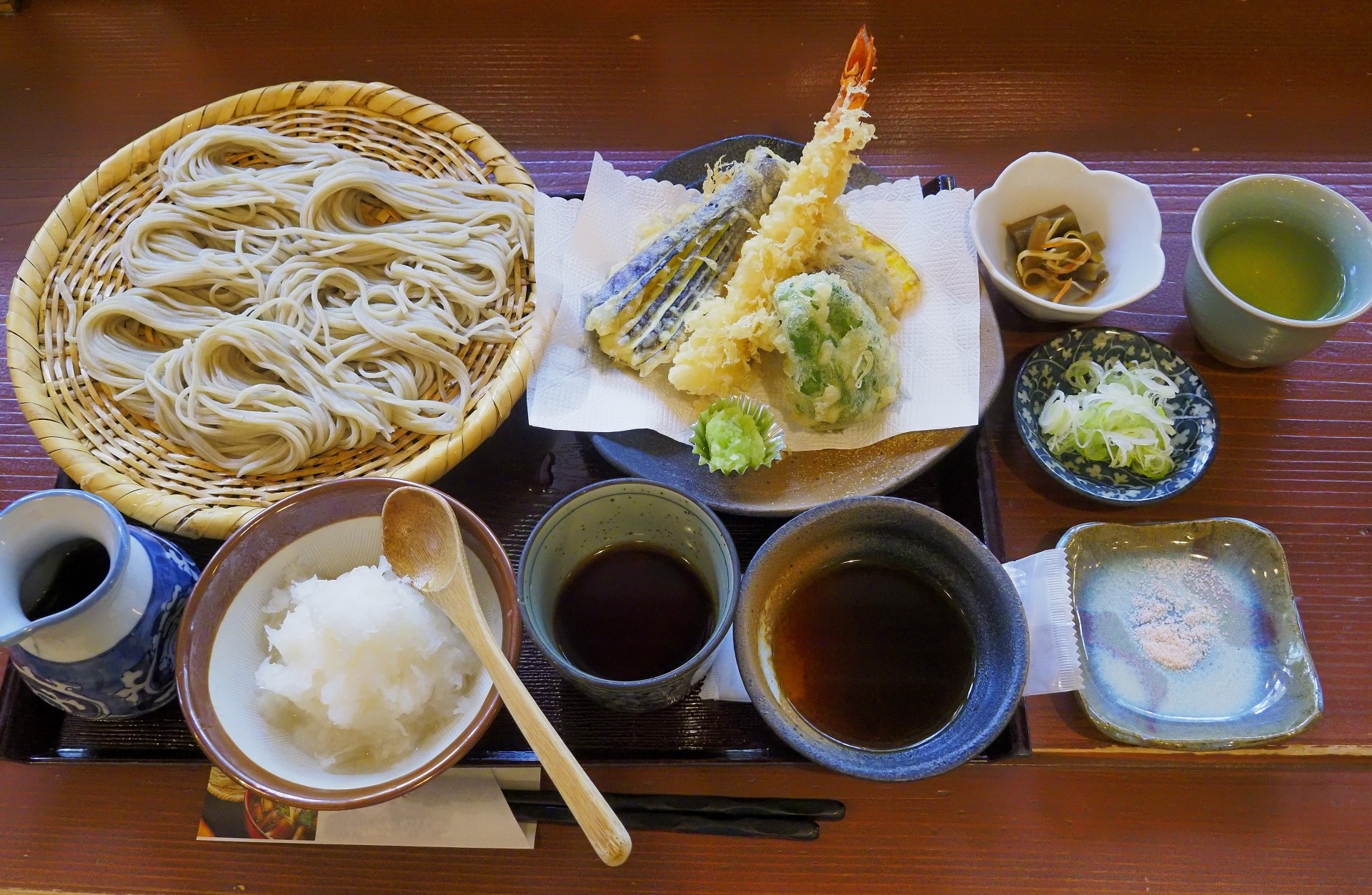
As the years went on, family outings started including proper soba restaurants. And at those restaurants, the order was always the same: cold tempura soba (冷たい天ぷらそば).
Springy shrimp tempura and vegetable tempura — especially eggplant. Some restaurants serve tentsuyu (天つゆ / tempura dipping sauce) alongside, with grated daikon to mix in. The standard approach is to use it as a separate dipping sauce for the tempura. Kaa-chan has never fully worked out the logic of when to use which sauce, and has always ended up eating everything together with the soba broth anyway. 😄 Kaa-chan's son, meanwhile, skips both sauces entirely and eats the tempura with salt while it's still crispy. Everyone has their own way.
These days, fried food has become a bit much, so tempura soba has quietly stepped back. The station kakiage has gone mini-size too. Just one of life's phases. 😄
The Basics — What to Know Before You Order
Kake, Mori, Zaru — What's the Difference?
Kake soba (かけそば) is the simplest version: hot noodles in hot broth. Kaa-chan orders this even in summer.
Mori soba (もりそば) is cold noodles served on a bamboo tray or wooden frame, with dipping broth on the side.
Zaru soba (ざるそば) looks almost identical to mori soba, with one difference: shredded nori on top. In practice, many restaurants serve one or the other but not both — the name varies by shop. If you're wondering which is which, nori on top means zaru.
Kaa-chan was curious about the history and looked it up: zaru soba gets its name from the bamboo basket (zaru) it was originally served on in the Edo period. Back then there was no nori involved — the nori topping came later, in the Meiji era. A small piece of noodle history. Confusing, but charming. 😄
Noodle Ratios — Juwari and Nihachi
Juwari soba (十割そば) is made from 100% buckwheat flour. The aroma is intense and the flavor is assertive — the most direct expression of the grain.
Nihachi soba (二八そば) blends 80% buckwheat with 20% wheat flour as a binder. Smoother, with a cleaner finish and better slip. Some shops use their own ratios — 90% buckwheat, or something else entirely — whatever they've decided produces the best noodle.
Soba-yu (そば湯) — The Great High School Incident
At restaurants serving cold soba, a small ceramic vessel of pale, cloudy liquid often arrives at the table — soba-yu (そば湯), the water left over from cooking the noodles.
In high school, Kaa-chan went to a soba restaurant with two close friends. Western food — pasta, hamburgers — was the usual territory, so cold zaru soba was a first for all three of them.
The restaurant was busy at lunch, so the soba-yu arrived at the table at the same time as the noodles. Nobody knew what it was.
"What do we do with this?"
"Just... pour it on the soba?"
So they did. The zaru has a bamboo grate underneath. The hot liquid went straight through and flooded the table. Chaos. All three of them burst out laughing. 😄
Those two friends are still close. Next time they meet, Kaa-chan is going to ask: "Do you remember the soba-yu incident?"
How to Actually Use Soba-yu
Soba-yu is the cooking water from the noodles — it carries the buckwheat flavor and nutrients, and it's gentle on the stomach. The standard way to enjoy it: pour it into your remaining dipping broth, diluting it to whatever strength you like, and drink it as a warm finish to the meal.
Kaa-chan loves it now. The aroma of dashi rises as the hot soba-yu hits the broth. Warming in a quiet way. One tip: the sediment tends to settle at the bottom of the vessel, so give it a gentle swirl — hold the lid down and rock it slowly — before pouring.
Kaa-chan's Tip: First Time at a Soba Restaurant
Start with kake soba or mori soba — something simple that lets the noodle's aroma and texture speak for itself.
If you're at a proper soba restaurant and want the full experience, Kaa-chan's recommendation is cold tempura soba. Crispy hot tempura alongside firm cold soba — then finish with soba-yu in the remaining broth. That's the complete version.
Forty years ago, the smell of dashi from a station stand pulled Kaa-chan through a door for the first time. The feeling hasn't changed.
If you're in Japan — find a bowl of soba. Any version. Just try one.
— Mogu Mogu Kaa-chan
A Japanese mom who once complained to a soba shop about noodle draining — and would absolutely do it again.